

Jackson Pollock
Jackson Pollock stands as one of the most influential American painters of the 20th century and the central figure of the Abstract Expressionist movement. During his lifetime, he achieved both widespread fame and intense controversy.
The Architect of American Abstract Expressionism
Introduction: A Revolutionary Figure in Modern Art
Pollock’s artistic significance lies in his development of one of the most radical abstract styles in modern art history — one that detached line from color, redefined the relationship between drawing and painting, and introduced entirely new ways of conceiving pictorial space.
Early Life and Formative Influences
Jackson Pollock was born in 1912 in Cody, Wyoming. His father, LeRoy Pollock, worked first as a farmer and later as a government land surveyor. Pollock spent much of his youth in Arizona and Chico, California, environments that exposed him to wide-open landscapes and Native American culture.
While accompanying his father on surveying trips, Pollock encountered Indigenous art and ritual practices. Although he later denied any deliberate imitation of Native American art, he acknowledged that similarities in his work likely stemmed from early memories and a lasting sense of enthusiasm shaped during these formative years.
Artistic Training and Early Career
In 1929, Pollock moved to New York City to study at the Art Students League under regionalist painter Thomas Hart Benton. Benton’s emphasis on rhythmic composition and movement left a lasting impression, even as Pollock later rejected representational approaches.
During the early 1930s, Pollock worked in a Regionalist style and absorbed influences from Mexican muralists such as Diego Rivera. At the same time, he became increasingly interested in Surrealism, particularly its emphasis on the subconscious, automatism, and emotional expression through nontraditional imagery.
The Impact of European Modernism
A pivotal moment in Pollock’s development occurred in November 1939, when the Museum of Modern Art in New York presented Picasso: 40 Years of His Art. The exhibition featured 344 works by Pablo Picasso, including the monumental anti-war painting Guernica.
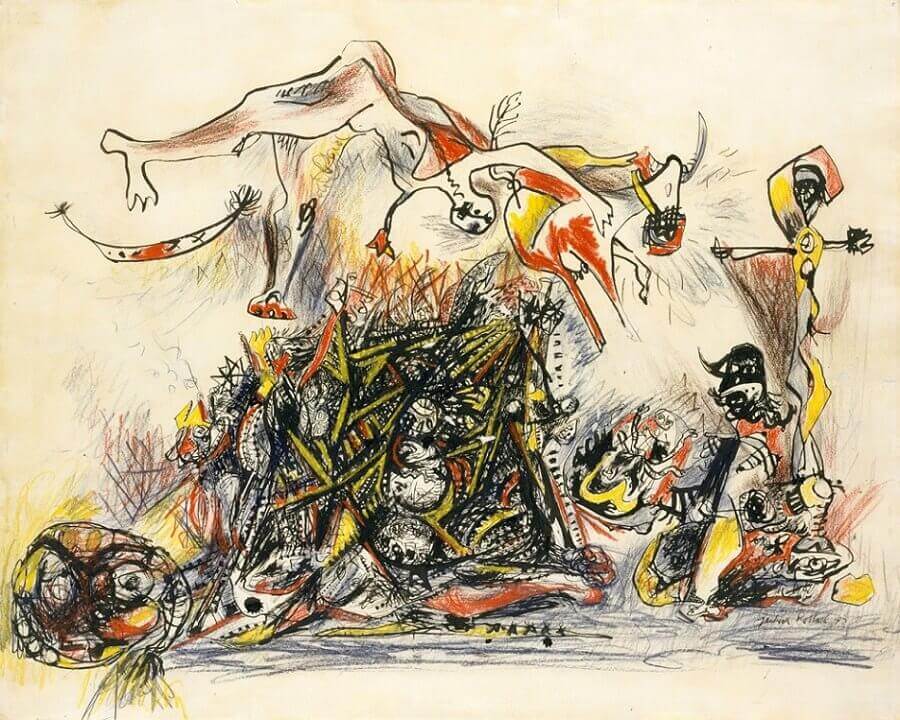
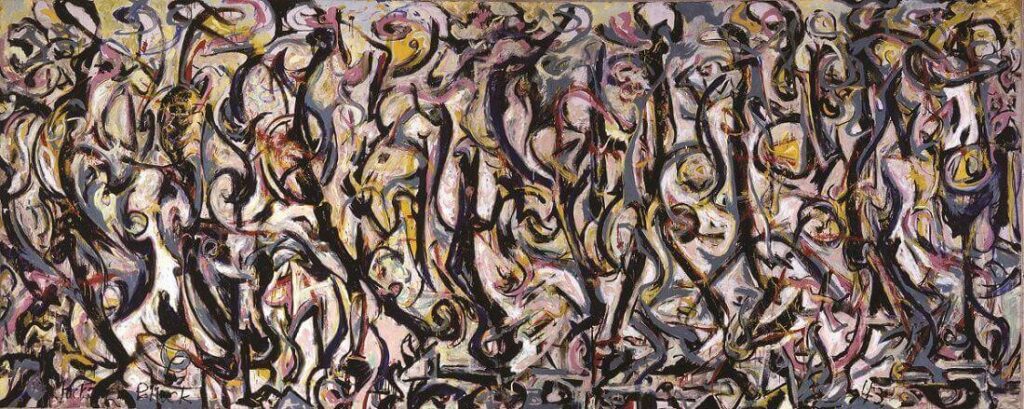
The exhibition profoundly affected Pollock, prompting him to reconsider European modernism, which he had previously resisted in favor of American artistic traditions. In its wake, Pollock began developing semi-abstract, totemic compositions marked by obsessive reworking and increasing symbolic complexity.
Abstract Expressionism and the Birth of Action Painting
In the aftermath of World War II, a new artistic vanguard emerged in New York City. Abstract Expressionism took shape amid widespread anxiety about human vulnerability, irrationality, and the consequences of modern life. Pollock, along with his contemporaries, sought to express these concerns through abstraction rather than representation.
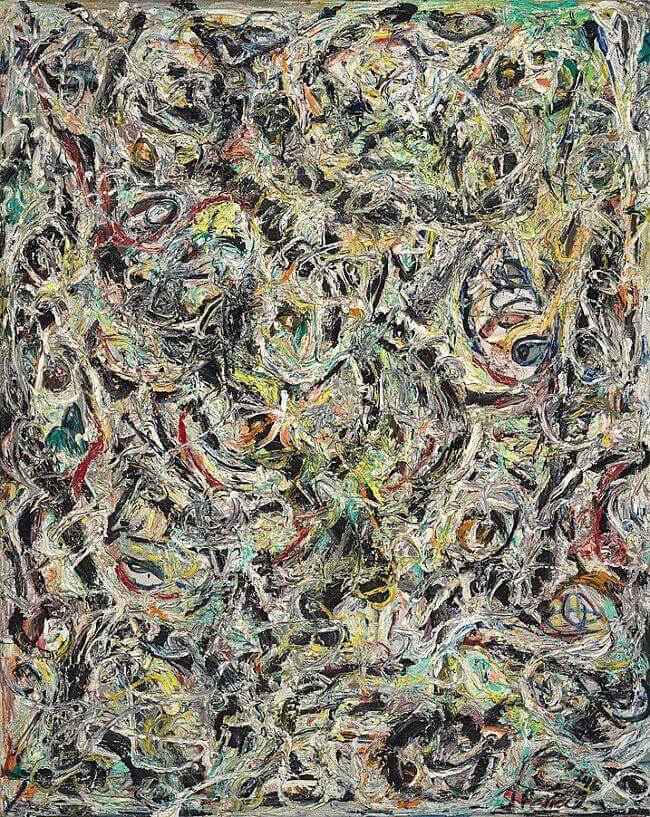
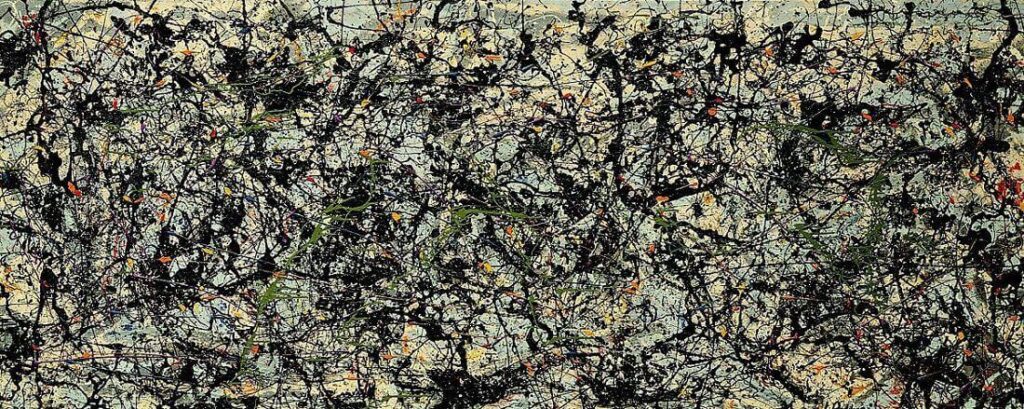
By the mid-1940s, Pollock introduced his most iconic innovation: the drip painting. This technique, later described as “action painting,” involved placing large canvases on the floor or against walls and allowing paint to drip, pour, or splatter directly from cans. Traditional brushes were often abandoned in favor of sticks, knives, and trowels.
Pollock explained his philosophy succinctly:
“The painting has a life of its own. I try to let it come through.”
~ Jackson Pollock
The resulting works were among the most original of the century, permanently altering the course of American art.
The All-Over Composition and New Spatial Logic
Closely associated with Pollock’s drip technique was his development of the “all-over” method of composition. These paintings rejected focal points and hierarchical organization. No single area of the canvas held more importance than another, creating a continuous field of visual energy.
Scale became irrelevant; the image bore no obvious relationship to the dimensions of the canvas. In many cases, Pollock trimmed or cropped the canvas after completion to suit the composition, further emphasizing process over predetermined form.
Media Attention and Cultural Fame
Pollock’s radical methods soon attracted national attention. In August 1949, Life magazine famously asked, “Is Jackson Pollock the greatest living painter in the United States?” The article alternated between skepticism and admiration but firmly placed Pollock at the center of public discourse.
In 1951, Vogue magazine published fashion photographs by Cecil Beaton featuring models posed in front of Pollock’s paintings. While this visibility signaled mainstream acceptance, it also reflected the mass culture’s appropriation of the avant-garde — an outcome Pollock viewed with ambivalence.
Artistic Shifts and Later Work
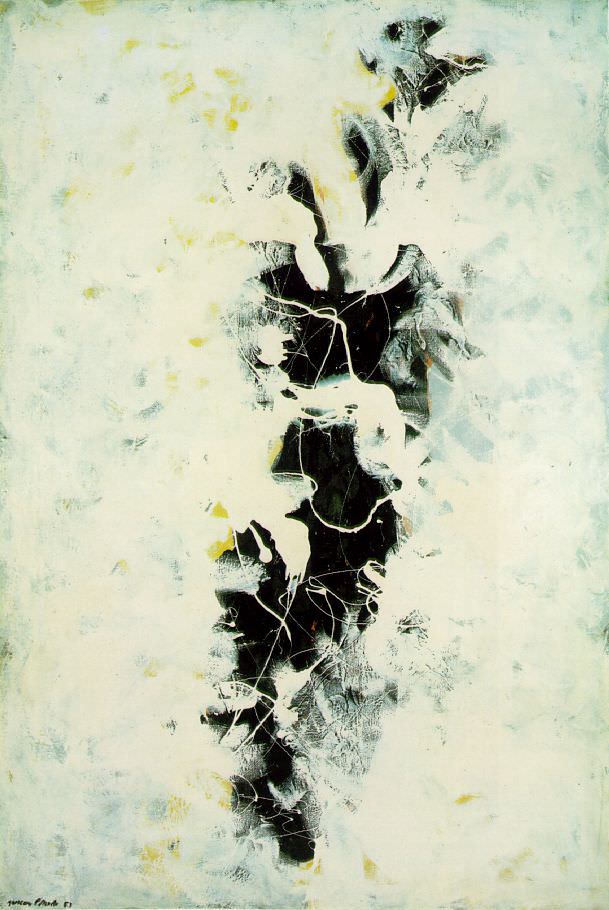
At the height of his fame, Pollock abruptly abandoned the drip technique. His post-1951 works grew darker in tone and color, including a series painted in black on unprimed canvas. These works, later called the “Black Pourings,” were exhibited at the Betty Parsons Gallery in New York but failed to sell.
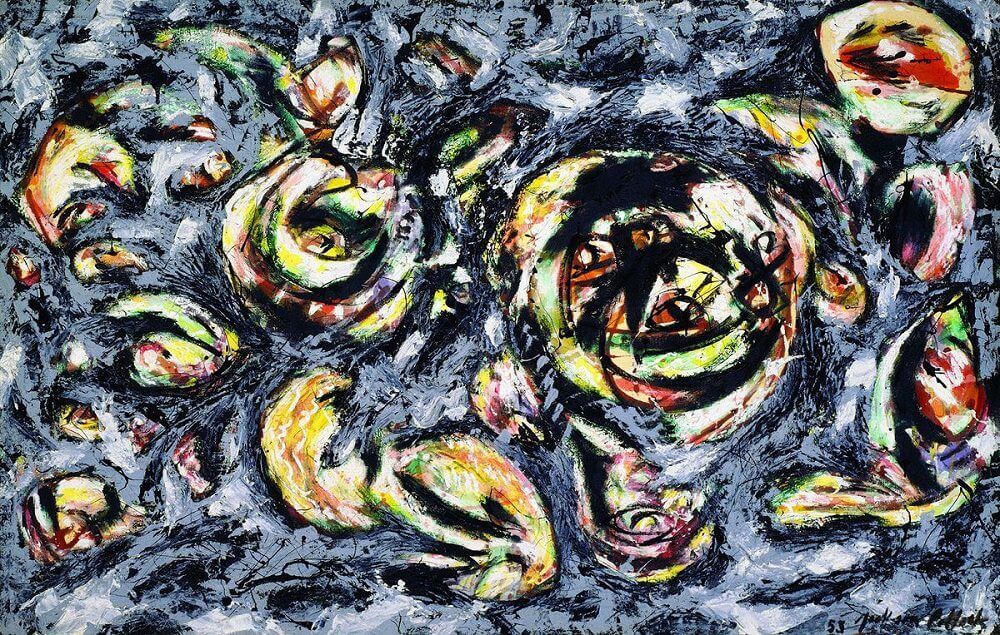
Subsequently, Pollock returned to color and introduced more figurative elements, coinciding with a move to a more commercially oriented gallery. These shifts reflected both artistic restlessness and uncertainty about public reception.
Personal Struggles and Mythic Legacy
By the 1960s, Jackson Pollock was widely regarded as one of the most important innovators in modern art. His struggles with alcoholism and personal instability contributed to his public image as a troubled genius. His premature death in a car accident further cemented his mythic status.
Enduring Influence and Historical Significance
Today, Jackson Pollock is recognized as a leader of the most significant American art movement of the 20th century. His willingness to take creative risks encouraged future artists to prioritize passion and authenticity over rigid conventions.
Pollock’s work also brought international attention to Abstract Expressionism as a whole, elevating figures such as Willem de Kooning, Arshile Gorky, Robert Motherwell, Barnett Newman, and Mark Rothko.
Much like Vincent van Gogh’s impact on Impressionism, Pollock’s influence on American Abstract Expressionism was transformative. He enabled American painting to stand alongside European modernism by redefining scale, surface, gesture, and spatial relationships. Drawing from sources as varied as Paleolithic art, Native American traditions, Renaissance masters, Mexican muralists, and Surrealists, Pollock forged a distinctly American visual language — defiant, volatile, and unprecedented.
In doing so, he emerged as an unlikely but enduring symbol of artistic innovation: an American Prometheus who reshaped the possibilities of modern art.